
US Gambling Statistics 2026: The Real Numbers
🕑 14 min read
Last updated: 21 June 2026. Every figure on this page is pulled from a named primary source, with the link right next to it. No guesses, no rounded-up marketing numbers.
The short version
Americans gave the legal casino business $78.72 billion in 2025, a record, and that’s only the commercial side. Throw in tribal casinos and the country’s legal gambling take clears $120 billion a year. Here is the part that should stick with you. On a slot machine the house keeps about 7 cents on the dollar you feed through it, but at the three-card poker table it keeps over 31 cents. Same casino, wildly different bite.
I have worked these floors for 50 years, and the numbers tell a story the marquee never will. Below is the whole picture: how much America bets, which states bet the most, what the house actually keeps off each game, where Las Vegas really earns its money, and how crypto and a new breed of phone games are quietly redrawing the map. Take the data, use it, just point back here when you do.

How much America gambles
US commercial gambling brought in a record $78.72 billion in 2025, up 9.2 percent on the year before, and every single one of the 38 legal markets grew. That figure comes straight from the American Gaming Association, the trade body that tracks it. That word “revenue” means gross gaming revenue, which is just the money players lost. What the casinos kept after paying out the winners.
The business splits into three buckets, and they’re not growing at the same speed. Old-fashioned slots and table games are still by far the biggest pile, but the online side is the part sprinting.
| Where the money came from (2025) | Player losses | Growth on 2024 |
|---|---|---|
| Slot machines and table games (in person) | $50.94 billion | +2.3% |
| Sports betting | $16.96 billion | +22.8% |
| Online casino (iGaming) | $10.74 billion | +27.6% |
| Total commercial gambling | $78.72 billion | +9.2% |
On sports betting, that $16.96 billion came off a staggering $166.94 billion that people actually wagered across the year. The gap between the two is the whole game in one line: you bet a huge number, the book hands most of it back to winners, and keeps roughly a tenth.
Now the number most people never hear. America’s tribal casinos pulled in another $43.9 billion in their 2024 fiscal year, a record, per the National Indian Gaming Commission. Stack tribal on top of commercial and Americans lose north of $120 billion a year at legal gambling, and we break down how much Americans really lose state by state in its own piece. The tribal and commercial counts cover slightly different 12-month windows, so treat that combined figure as a fair ballpark, not an exact sum.
Which states gamble the most
Nevada still leads the country, but the gap is closing fast as online states pile up revenue. These are the five biggest commercial gambling markets in 2025, from the American Gaming Association and confirmed against each state’s own regulator.
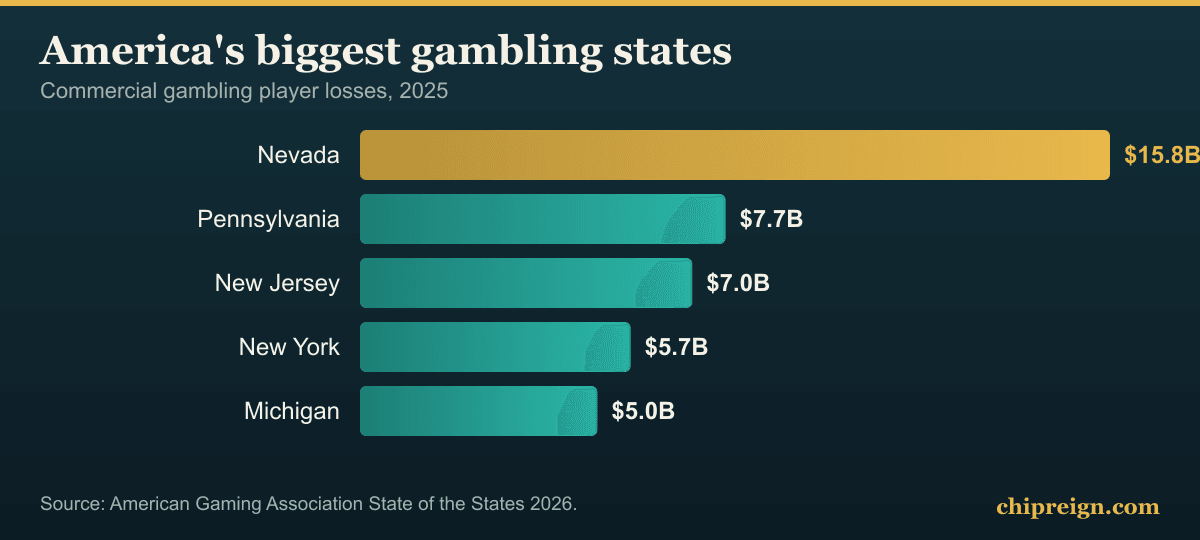
| State | Player losses (2025) |
|---|---|
| Nevada | $15.8 billion |
| Pennsylvania | $7.7 billion |
| New Jersey | $7.0 billion |
| New York | $5.7 billion |
| Michigan | $5.0 billion |
Online casino is where the real shift is happening, and it’s lopsided. Just three states take roughly 90 cents of every dollar lost to legal online casino play in America.
| Online casino leaders (2025) | Player losses |
|---|---|
| Pennsylvania | $3.46 billion |
| Michigan | $3.09 billion |
| New Jersey | $2.91 billion |
| All US online casino | $10.74 billion |
Here is a marker that tells you where this is all heading. In 2025, both New Jersey and Pennsylvania made more from online casino than from their brick-and-mortar casino floors for the first time ever. The phone in your pocket is out-earning the building. Only eight places let you play online casino legally so far: New Jersey, Pennsylvania, Michigan, Connecticut, West Virginia, Delaware, Rhode Island, plus Nevada for online poker only.
What the house actually keeps
Every casino game has a built-in edge for the house, and it’s no secret. You need to know two different numbers, because casinos and gamblers mean different things when they say “the house wins.”
The first number is the house edge. That is the cut the math takes out of a single bet, assuming you play it right. Think of it as what one $100 bet costs you on average. The figures below are the standard ones from Wizard of Odds, the gambling-math reference the industry itself trusts.
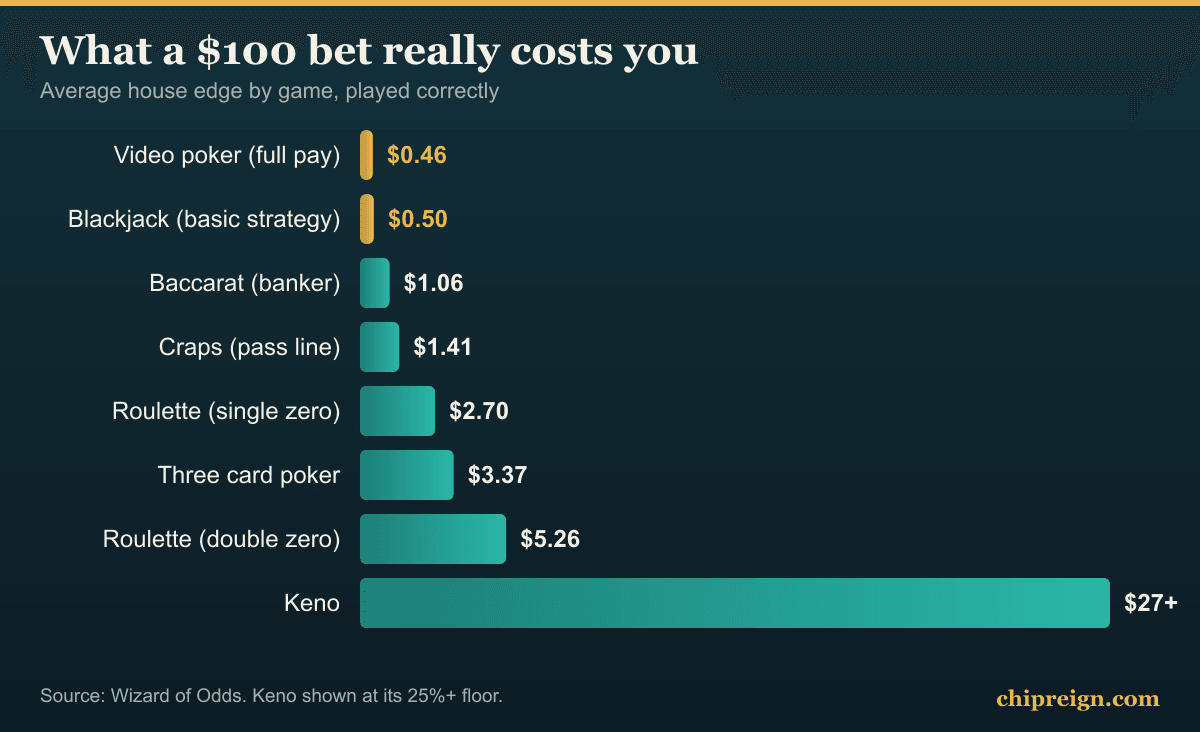
| Game | House edge | What a $100 bet costs you |
|---|---|---|
| Blackjack (basic strategy) | 0.5% | about 50 cents |
| Video poker (full-pay Jacks or Better) | 0.46% | about 46 cents |
| Baccarat (banker bet) | 1.06% | about $1.06 |
| Craps (pass line) | 1.41% | about $1.41 |
| Roulette (single zero) | 2.70% | about $2.70 |
| Three card poker | 3.37% | about $3.37 |
| Roulette (double zero) | 5.26% | about $5.26 |
| Slots (typical) | 2% to 15% | $2 to $15 |
| Keno | 25% or more | $25 or more |
Look at that spread. Played right, blackjack costs you about 50 cents per $100, while keno quietly takes 25 bucks of the same hundred. For the full ranking and the strategy behind it, we break down every casino game by house edge in its own guide.
But here’s the second number, and it’s the one that actually empties wallets. It is called the hold, and it’s what the casino keeps of every dollar you bring to the table, not every dollar you bet. The two are miles apart, because you don’t bet your money once. You bet it, win some back, bet that, and so on, and the edge nibbles each time around. Nevada’s regulators publish exactly what the state’s casinos held off each game in 2025, compiled by the UNLV Center for Gaming Research.
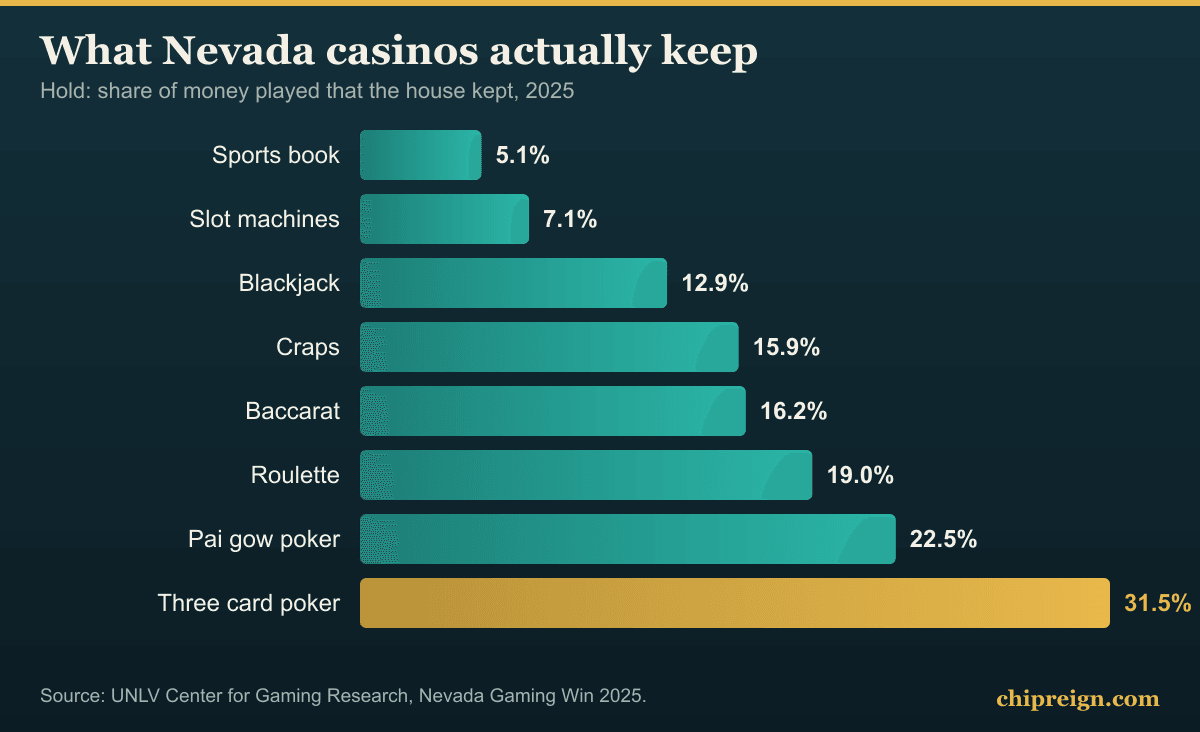
| Game | What Nevada casinos actually kept (2025) |
|---|---|
| Sports book | 5.1% of money wagered |
| Slot machines | 7.1% of money played through |
| Blackjack | 12.9% of chips bought |
| Craps | 15.9% of chips bought |
| Baccarat | 16.2% of chips bought |
| Roulette | 19.0% of chips bought |
| Pai gow poker | 22.5% of chips bought |
| Three card poker | 31.5% of chips bought |
See the gap on blackjack? The edge is half a percent, but the hold is nearly 13 percent. That isn’t the casino cheating. That is people sitting down with a hundred dollars, betting it over and over for an evening, and walking out having lost a chunk of it to a tiny edge applied many times. The lesson Chip would give a first-timer: a low house edge only saves you if you also play fewer hands and quit while you’re even. For the full breakdown, see what the house actually keeps off every game. We cover which games you can actually get an edge on separately, and the short list is shorter than you would hope.
Las Vegas by the numbers
Las Vegas drew 38.5 million visitors in 2025, and 81 percent of them gambled, the highest share in five years, per the Las Vegas Convention and Visitors Authority. The average visitor set aside $848.95 for gambling that trip, also a five-year high, and spent about 2.6 hours a day at it. Gambling budgets are up 18 percent since 2021 even as the crowds thinned. Fewer people, betting more. That is the modern Strip in a nutshell.
Now the fact that surprises almost everyone. On the Las Vegas Strip, gambling isn’t even close to the biggest earner anymore. The Nevada Gaming Control Board’s Gaming Abstract shows where Strip resorts really make their money.
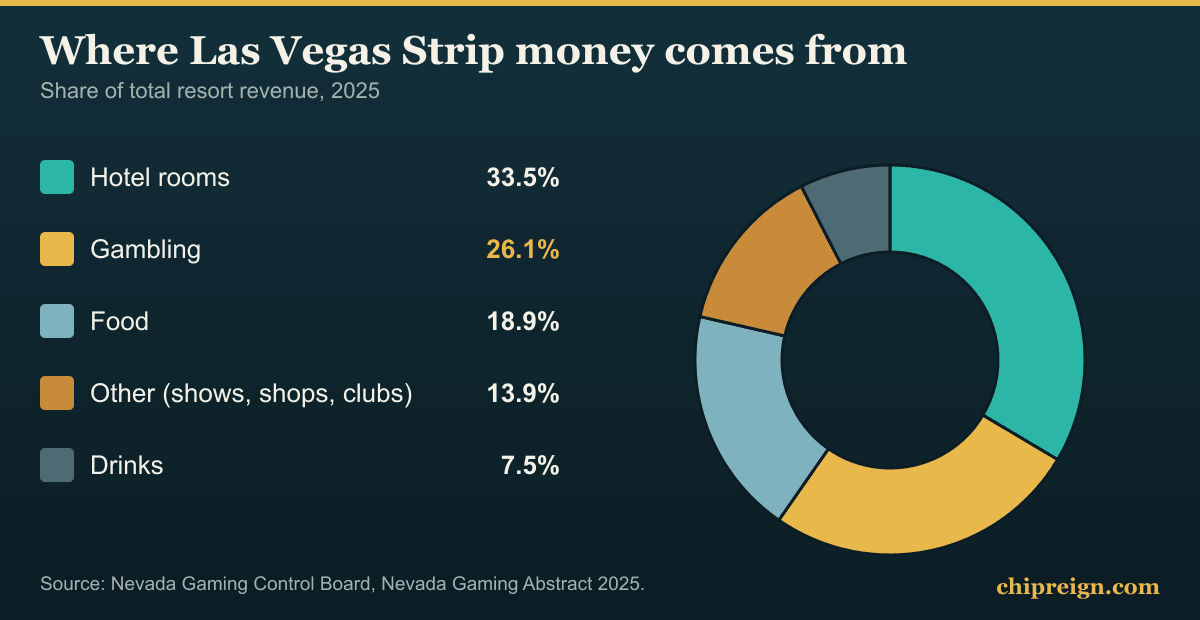
| Where Strip resorts earn (2025) | Share of total revenue |
|---|---|
| Hotel rooms | 33.5% |
| Gambling | 26.1% |
| Food | 18.9% |
| Other (shows, shops, clubs) | 13.9% |
| Drinks | 7.5% |
Gambling is now about a quarter of Strip revenue. Nearly three-quarters comes from the room, the steak, the show and the cabana. The casino floor turned into the loss leader that gets you in the door so the resort can sell you everything else. We dig into how much Las Vegas really makes, and where, in its own piece.
And on the tables that are left, one game towers over the rest. Baccarat, the quiet high-roller game most tourists walk straight past, brings in 43 percent of all Strip table-game revenue, per UNLV’s Strip table mix data. Blackjack, the people’s game, has slid from more than half of table revenue back in 1985 to about 28 percent today. The Strip increasingly runs on whales betting fortunes on a coin-flip card game. I have watched a single baccarat player swing more in one shoe than a blackjack pit earns in a week. If that world fascinates you, read up on the whales and on baccarat itself.
Crypto gambling by the numbers
Crypto casinos have grown from a fringe corner into a giant that nobody fully measures, because most of them operate offshore and report to no regulator. The most-cited figure puts global crypto casino losses at around $81.4 billion in 2024, roughly five times what they were in 2022. That number comes from the monitoring firm Yield Sec, as reported by the Financial Times. Treat it as the best estimate going, not gospel, because no government audits this market.
One site shows the scale. Stake.com, the biggest crypto casino, took an estimated $4.7 billion in player losses in 2024, again per Financial Times reporting. That would put a single offshore website in the same revenue league as some of the largest licensed gambling companies on earth.
A few patterns are clear even without clean numbers. Stablecoins, the crypto coins pegged to the dollar like USDT and USDC, have overtaken Bitcoin as the way most players move money in and out, because nobody wants their bankroll swinging 10 percent while they sleep. And nearly every crypto casino now runs on “provably fair” games, a system that uses cryptographic codes to let you check, after the fact, that a result wasn’t rigged. We explain how crypto casinos and provably fair actually work in plain English, and which coins are fastest and cheapest to cash out. For the full scale of it, see crypto gambling by the numbers. One honest warning: most of these sites hold only an offshore license and block or ignore players in the US, the UK and much of Europe.
The new games eating the old order
A new kind of game is rewriting what “casino” even means, and it was born on crypto sites. Crash games like Aviator, plus one-tap games like Plinko, are dead simple: a multiplier climbs, you cash out before it crashes, the whole round lasts seconds. Spribe, which makes Aviator, says players wagered around 160 billion euros on that one game in 2025 across its partner sites. That is the studio’s own figure, so read it as a sales pitch, but even discounted it’s enormous.
Meanwhile the game that defined a generation is standing still. Online poker brought New Jersey just $30.3 million in 2025, against $2.88 billion from that state’s online slots and tables. Poker is barely one percent of New Jersey’s online gambling. The kids on their phones in Lagos, Mumbai and Sao Paulo aren’t grinding Texas Hold’em. They are tapping a rocket and watching a number climb. I have a lot of love for the old games, and the full story of how the new ones took over is worth its own read, which is why we wrote it up in crash games versus the classics.
The real cost: problem gambling
None of these numbers mean a thing without this one. About 2.5 million American adults, roughly one in a hundred, have a severe gambling problem in any given year, and another 5 to 8 million have a mild or moderate one, per the National Council on Problem Gambling. The Council puts the yearly social cost, things like bankruptcy, lost jobs and the rest, at around $14 billion.
The risk isn’t spread evenly. In the Council’s 2024 national survey, close to 20 million adults said they had run into a gambling problem behavior many times in the past year, and 15 percent of adults aged 18 to 34 reported worrying habits. That is the same young, mobile, always-on crowd the new games are built for. If gambling has stopped being fun for you or someone you know, help is free and it works. The numbers for the US, UK and Australia are at the bottom of this page.
Use this data (free)
Writers and researchers, help yourself. We packaged the main tables on this page, the house edges, the real Nevada hold percentages, and the revenue figures, into clean files you can open in any spreadsheet. They are free to use. All we ask is a link back to this page so readers can check the sources.
Every figure here traces to a public, primary source: the American Gaming Association, the Nevada Gaming Control Board, the UNLV Center for Gaming Research, the National Indian Gaming Commission, the Las Vegas Convention and Visitors Authority, the National Council on Problem Gambling, and the gambling-math reference Wizard of Odds. Links sit beside each number above.
Chip’s bottom line
The numbers say what the neon never will. America bets more every year, the online side is eating the floor, Las Vegas makes most of its money off your hotel room and your dinner, and one quiet game played by the very rich pays for a big slice of the Strip. The house edge is small, but you hand it your money over and over, which is how a half-percent game still empties a wallet. Know the real numbers, set a budget like the Strip sets yours, and treat the whole thing as the price of a night out. That is the only way the math ever works in your favor.
FAQ
How much do Americans lose gambling each year?
Legal commercial casinos and sportsbooks kept a record $78.72 billion in player losses in 2025, per the American Gaming Association. Add tribal casinos, which took $43.9 billion in their 2024 fiscal year, and total legal gambling losses clear $120 billion a year.
Which casino game has the best odds?
Blackjack played with correct basic strategy has the lowest house edge of the common games, around 0.5 percent, meaning a $100 bet costs about 50 cents on average. Full-pay video poker is similar. Keno is the worst, taking 25 percent or more.
What is the difference between house edge and hold?
House edge is what the math takes from a single bet. Hold is what the casino keeps of all the money you brought, after you’ve bet it many times over. Blackjack has a tiny 0.5 percent edge but Nevada casinos held nearly 13 percent of the chips players bought in 2025, because people bet the same money again and again.
Does Las Vegas make most of its money from gambling?
No, not anymore. On the Las Vegas Strip in 2025, gambling was 26 percent of resort revenue. Hotel rooms, food, drinks and entertainment made up the other 74 percent, per the Nevada Gaming Control Board.
How big is crypto gambling?
The best available estimate puts global crypto casino player losses at about $81.4 billion in 2024, roughly five times the 2022 figure, according to the firm Yield Sec as reported by the Financial Times. The market is offshore and unregulated, so no official total exists.
How many Americans have a gambling problem?
About 2.5 million US adults have a severe gambling problem in a given year and another 5 to 8 million have a mild or moderate one, per the National Council on Problem Gambling. Free, confidential help is available at 1-800-MY-RESET.
ChipReign is independent and doesn’t currently earn commission from any operator. ChipReign publishes content for adults aged 18+ (21+ in certain US jurisdictions). If you or someone you know is struggling with gambling, free and confidential help is available: National Problem Gambling Helpline (US) 1-800-MY-RESET; GamCare (UK) 0808 8020 133; Gambling Help Online (Australia) 1800 858 858.
More Casino Basics
KYC and Casino Verification Explained: Why They Ask and How to Pass
Why a casino asks for your ID before paying out, what documents you need, when it happens, and…

Sweeps Rules You’ll Break by Accident
One account per person, not per household. The household clause is about staff. What three operators actually publish,…

The History of the Slot Machine: From Liberty Bell to Megaways
From Charles Feys 1895 Liberty Bell and the one-armed bandit to fruit symbols, Money Honey, video slots and…