
Crypto Gambling by the Numbers: 2026 Statistics
🕑 7 min read
Last updated: 21 June 2026.
The short version
Crypto gambling went from a fringe corner to a giant in a few short years. The best estimate going puts global crypto casino losses at around $81.4 billion in 2024, roughly five times what they were in 2022. A single site, Stake.com, is reckoned to have taken about $4.7 billion on its own, which would put one offshore website in the same league as the biggest licensed gambling firms on the planet.
One honest warning before the numbers. Nobody regulates this market, so nobody audits it. Every figure here’s an estimate, and I’ll tell you exactly where each one comes from and how much to trust it. That is the only fair way to count a business that operates in the shadows. Here is crypto gambling by the numbers.

How big crypto gambling got
The number you’ll see everywhere is $81.4 billion in player losses for 2024. It is worth knowing where that comes from. It traces to a monitoring firm called Yield Sec, reported by the Financial Times. Just about every other site quoting that figure is repeating the same single source. So treat it as the best estimate available, not a hard fact, because no government counts this.
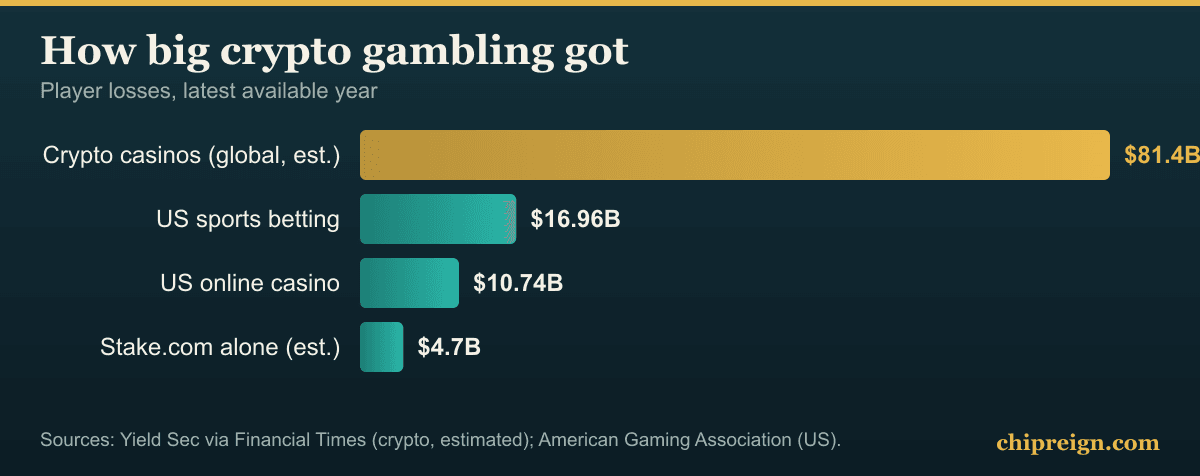
What isn’t in doubt is the direction. Crypto casino losses are reckoned to have grown around fivefold since 2022. That is explosive by any measure, and it’s happening while the regulated online gambling market grows at a steady but ordinary pace of around 12 percent a year. The chart above puts the estimated crypto figure next to America’s regulated online verticals so you can see the scale. Crypto gambling, if the estimate is even close, dwarfs the entire legal US online casino market.
One site the size of an industry
Stake.com is the giant of crypto gambling. Financial Times reporting put its 2024 player losses at roughly $4.7 billion. To put that in perspective, that’s one website earning in the same range as some of the largest licensed gambling companies in the world, the kind with thousands of staff and shares on a stock exchange.
Stake built its name on simple in-house games, crash, plinko, dice, mines, plus a huge sportsbook and a wall of celebrity sponsorships. It is blocked or unlicensed in big markets like the US and the UK, yet it became a household name in crypto circles anyway. That gap, between how big these sites are and how few places officially allow them, is the whole strange story of crypto gambling.
Why stablecoins took over
Early crypto gambling ran on Bitcoin. These days most of it runs on stablecoins, the crypto coins pegged to the dollar like USDT and USDC. The reason is obvious once you’ve sat at a table. Nobody wants their bankroll swinging 10 percent overnight on top of the gambling. A stablecoin holds its value, so a hundred dollars in is still a hundred dollars when you cash out, give or take.
The exact split between stablecoins and volatile coins isn’t something any neutral source measures cleanly, so I won’t put a false number on it. But the shift toward stablecoins is widely reported and matches what the cashier menus show: USDT, usually on the cheap Tron network, has become the default in and out. We explain the whole thing in stablecoin gambling explained, and which coins cash out fastest and cheapest.
Provably fair, explained
Crypto casinos brought one genuinely new idea to gambling, and it’s called provably fair. In a normal casino you trust that the slot machine is honest because a regulator checked it. On a crypto site, provably fair lets you check a result yourself, after the fact, using cryptographic codes the site commits to before the bet is made.
In plain terms: the site locks in a secret number before the round, mixes it with a number from you, and shows its work afterward so you can confirm the outcome wasn’t changed once you bet. It doesn’t make the odds any better, the house edge is still there, but it does mean you can verify the deal was straight. Nobody has a reliable count of how widely it’s used, so anyone quoting a precise adoption percentage is guessing. What is true is that provably fair has gone from a novelty to the standard selling point of the whole sector. We break down how it works in crypto casinos explained.
The catch: it runs in the shadows
Here is the part the big numbers hide. Most crypto casinos hold only an offshore license, from places like Curacao or Anjouan, and block or simply ignore players in the US, the UK and much of Europe. People reach them anyway through workarounds, which means a lot of this $81 billion is money flowing through sites that answer to no real regulator.
That matters for you in concrete ways. There is often no real protection if a site refuses to pay, no enforced limits, and far weaker checks than a licensed operator faces. The flip side, the privacy and the speed, is exactly why people use them, and it’s a real draw. Just go in clear-eyed. We cover the trade-offs honestly in is crypto gambling anonymous. For the full picture of legal and crypto gambling side by side, see our US gambling statistics page.
Chip’s bottom line
Crypto gambling is enormous, growing fast, and almost entirely unmeasured, which is a strange thing to say about an $80 billion business. The headline numbers are estimates from a single firm, so quote them as such. What is solid is the shape of it: a handful of offshore sites the size of public companies, running mostly on stablecoins, selling provably fair as their badge of trust, and operating outside the rules most of their players live under. The technology is genuinely clever. The lack of a referee is the part to respect. Know that going in, and you’ll judge these sites for what they really are.
FAQ
How big is the crypto gambling market?
The best available estimate puts global crypto casino player losses at about $81.4 billion in 2024, roughly five times the 2022 figure, according to the firm Yield Sec as reported by the Financial Times. The market is offshore and unregulated, so no official total exists.
What is the biggest crypto casino?
Stake.com, with estimated 2024 player losses of about $4.7 billion per Financial Times reporting. That puts a single website in the revenue range of some of the largest licensed gambling companies in the world.
Why do crypto casinos use stablecoins?
Stablecoins like USDT and USDC are pegged to the dollar, so a player’s balance doesn’t swing in value while they gamble. Most crypto gambling has shifted from Bitcoin to stablecoins for exactly that reason.
What does provably fair mean?
It is a system that lets you verify a game result wasn’t tampered with, using cryptographic codes the site commits to before your bet. It doesn’t lower the house edge, but it lets you confirm the deal was straight.
Are crypto casinos legal?
Most hold only an offshore license and block or ignore players in regulated markets like the US, UK and much of Europe. That means weaker player protection and little recourse if a site refuses to pay, which is the main risk to weigh.
ChipReign is independent and doesn’t currently earn commission from any operator. ChipReign publishes content for adults aged 18+ (21+ in certain US jurisdictions). If you or someone you know is struggling with gambling, free and confidential help is available: National Problem Gambling Helpline (US) 1-800-MY-RESET; GamCare (UK) 0808 8020 133; Gambling Help Online (Australia) 1800 858 858.
Related: Best Crypto Casinos 2026 · Are Crypto Casinos Legal?
More Casino Basics

Biggest Casino Heists Ever: 5 Bold Casino Robberies
From the Bellagio Biker Bandit to the Stardust cashier who walked out and vanished, the 5 boldest casino…

Casino Glossary: Every Term You’ll Hit, in Plain English
Around 170 casino terms in plain English, from wagering and game weighting to sweeps coins and the 2026…

The Psychology of Gambling: Why Your Brain Loves to Play
Dopamine, variable-ratio reinforcement, the near-miss effect and loss-chasing: the real psychology of why gambling hooks the brain, and…