Are Prediction Markets Gambling? The Honest Answer
Last updated: June 2026
Prediction markets are legally treated as financial contracts, not gambling, which is the whole basis for federal regulation. But in plain terms, trading the outcome of a ball game works a lot like a bet. Both things are true at once, and which one you are really doing depends on the contract and on you.
This guide is written for US readers. It walks through why the law calls it finance, why it looks like gambling, and why the label actually matters for your money, your taxes and your protections.
Not legal or financial advice. This page is general information only. The law here is contested and changing. For advice on your situation, speak to a qualified professional in your jurisdiction.
The short answer
Under the law, a prediction market trade is a financial contract regulated by a federal markets regulator, not a wager regulated by a gaming board. That is the official answer, and it is the reason platforms like Kalshi can operate across state lines.
The honest answer is messier. Some of these contracts really are financial tools. Others are sports bets with a clean app and a different regulator. Here is how to tell them apart and why it matters to you.
Why the law calls it a financial contract
The legal case rests on the idea of an event contract as a derivative, the same broad family as a futures contract on oil or wheat. The Commodity Futures Trading Commission, the CFTC, regulates it on that basis.
The argument has two planks. The first is price discovery, a fancy term for a simple thing: when thousands of people put real money behind their opinion, the price becomes a useful, public read on how likely an event is. A market saying there is a 70 percent chance of a rate cut is genuinely informative. The second is hedging. A farmer can hedge a bad harvest, and in the same spirit a business could use an event contract to offset a real-world risk. Those are the things financial markets exist to do, which is why the law treats them as finance. For the full detail, see how the CFTC regulates prediction markets.
Why it looks exactly like gambling
The other side is just as obvious. You stake money on an uncertain outcome, you win a fixed amount if you are right, and you lose your stake if you are wrong. That is the shape of a bet.
And the numbers give the game away. By early 2026, roughly 87 percent of the money traded on Kalshi was riding on sports. A contract on who wins Sunday’s game is not hedging a harvest. It is a wager on a result, dressed in the language of finance. State regulators and the casino industry make exactly this point, and it is a fair one. When the bulk of the volume is sports, calling the whole thing a financial product is a stretch.
Why the label actually matters
This is not a word game. Whether a thing is “gambling” or “a financial contract” changes real, practical stuff for the person putting money down.
It changes who regulates it, the CFTC instead of a state gaming board. It changes where it is legal, since a federally regulated contract can reach states where sports betting is banned. It can change how your winnings are taxed, because event contracts are not taxed the same way as a sportsbook ticket. And it changes your consumer protections, since the responsible-gambling tools a licensed sportsbook must offer are not automatically built into a financial exchange. So the label is not academic. It decides the rules you play under.
Prediction market or sportsbook?
They feel similar, but the machinery underneath is different. A sportsbook sets the odds and takes the other side of your bet. A prediction market matches you against other traders, like a stock exchange.
That difference has real effects. On an exchange you can often get a better price, and you can sell your position before the event ends to lock in a profit or cut a loss, which a standard sportsbook ticket will not let you do. But a sportsbook comes with state licensing, mandatory responsible-gambling tools and a clear legal status in the states where it operates. A prediction market gives you flexibility and federal oversight, and asks you to bring your own discipline. Neither is automatically better. They are different tools with different guardrails.
Our honest take
Both things are true, and pretending otherwise helps nobody. The economic and political markets are a genuine financial tool. The sports markets are sports betting wearing a suit.
Neither of those is shameful. We cover sports betting and casinos here without flinching. The point is to be clear-eyed about what you are doing. If you are trading a Fed decision to hedge a view on rates, that is finance. If you are buying “Yes” on your team to win the title with money you cannot afford to lose, the category in the app store does not change the truth: that is a bet, and you should treat it with the same care. Read our responsible gambling hub if the line ever starts to blur for you.
Frequently asked questions
Are prediction markets legally gambling?
No. At the federal level they are treated as financial contracts regulated by the CFTC, not gambling. That classification is the basis for their regulation and their reach across state lines. A number of states dispute this for sports contracts and argue they are gambling under state law, which is the heart of the legal fight.
Is trading on Kalshi the same as betting?
It depends on the contract. A market on an economic figure works like a financial hedge. A market on a sports result works like a bet. The mechanics are different from a sportsbook, since you trade against other people rather than a bookmaker, but the risk to your money is real either way.
Why are prediction markets not regulated as gambling?
Because event contracts are classed as derivatives, a type of financial instrument, and Congress gave the CFTC authority over those. The platforms argue the markets serve price discovery and hedging, which are financial functions. Critics say that when most volume is on sports, the financial label does not fit.
Is a prediction market better than a sportsbook?
Neither is simply better. A prediction market often gives a sharper price and lets you sell out early, with federal oversight. A licensed sportsbook gives clear state-legal status and built-in responsible-gambling tools. The right pick depends on what you value and what is legal where you live.
Do prediction markets have responsible gambling tools?
Not in the same mandatory way a licensed sportsbook does. Because they are regulated as financial exchanges, the deposit limits and self-exclusion programs that a state forces on a sportsbook are not guaranteed. So you need to bring your own limits. Use the help lines in our footer if you need them.
Can prediction markets be addictive?
Yes. Any fast, real-money market on outcomes can be, especially the sports contracts that behave like betting. The flexibility to trade in and out at any time can make it easier to chase losses. If you notice that pattern, treat it exactly as you would problem gambling and reach out for help.
Are prediction market winnings taxed like gambling?
Not necessarily, and this is unsettled. Because they are financial contracts rather than gambling, the tax treatment can differ, and the IRS has not issued specific guidance. Either way, the profits are taxable. See our guide to tax on prediction market winnings.
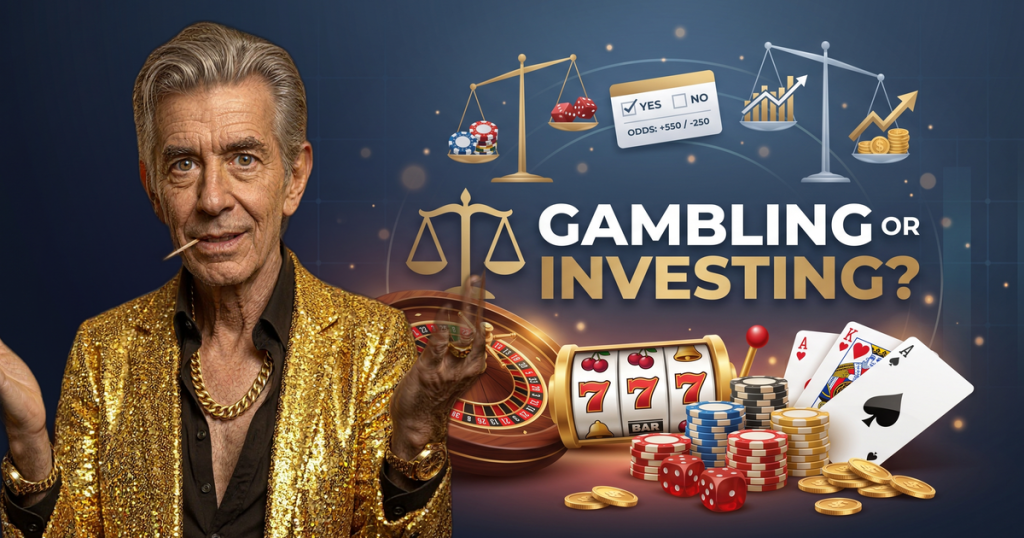
Should I think of this as investing or gambling?
Be honest with yourself about the specific contract. Hedging a real risk or trading a considered view on the economy leans toward investing. Backing your team with money you would miss is gambling, whatever the app calls it. The safest mindset is to treat any contract you cannot afford to lose as a bet.
Related ChipReign guides
- Prediction markets: an honest beginner’s guide
- Are prediction markets legal? State-by-state guide
- How prediction markets are regulated
- Responsible gambling hub
Questions about this guide? Email editorial@chipreign.com.
Responsible play. Prediction markets are real-money risk, for adults only, 18 and over, or 21 and over where local law requires. This page is general information, not legal or financial advice. If it stops being fun or you are chasing losses, step away. In the US call or text the National Problem Gambling Helpline at 1-800-MY-RESET. In the UK, GamCare is on 0808 8020 133. In Australia, Gambling Help Online is on 1800 858 858.